50 Years of Stillberg - Switzerland: From Avalanche Protection to Climate Research
This autumn around 250 visitors gathered in the Dischma Valley near Davos to celebrate a remarkable milestone: the 50th anniversary of the Stillberg experimental afforestation site. The event offered a rare opportunity to look back at half a century of research at one of the Alps’ most important long-term environmental research sites—and to reflect on its growing relevance in a rapidly changing climate.
Enjoy beautiful views from the Stillberg site in the new eLTER Sites and Platforms Series video!
Why plant a forest at the treeline?
Why did the Swiss Federal Institute for Forest, Snow and Landscape Research (WSL) and the WSL Institute for Snow and Avalanche Research (SLF) plant around 92,000 trees on the steep slopes of Stillberg?
During guided tours and discussions, researchers from WSL and SLF explained how the site was established in 1975 as a large-scale experimental afforestation effort in an avalanche-prone area at the alpine treeline. Three treeline-forming species in the European Alps, European larch, Swiss stone pine, and mountain pine, were planted from 2075 to 2230 m a.s.l. The goals were to understand which tree species can survive under extreme conditions - and at what height and density trees begin to provide effective protection against avalanches. Visitors also learned how factors such as snow cover, and soil conditions influence tree growth and survival at high elevations.
Complementing these explanations, a series of research posters showcased decades of data collection and experimentation, illustrating how the focus of Stillberg research has evolved over time.
Click here to view posters, presented at the event!
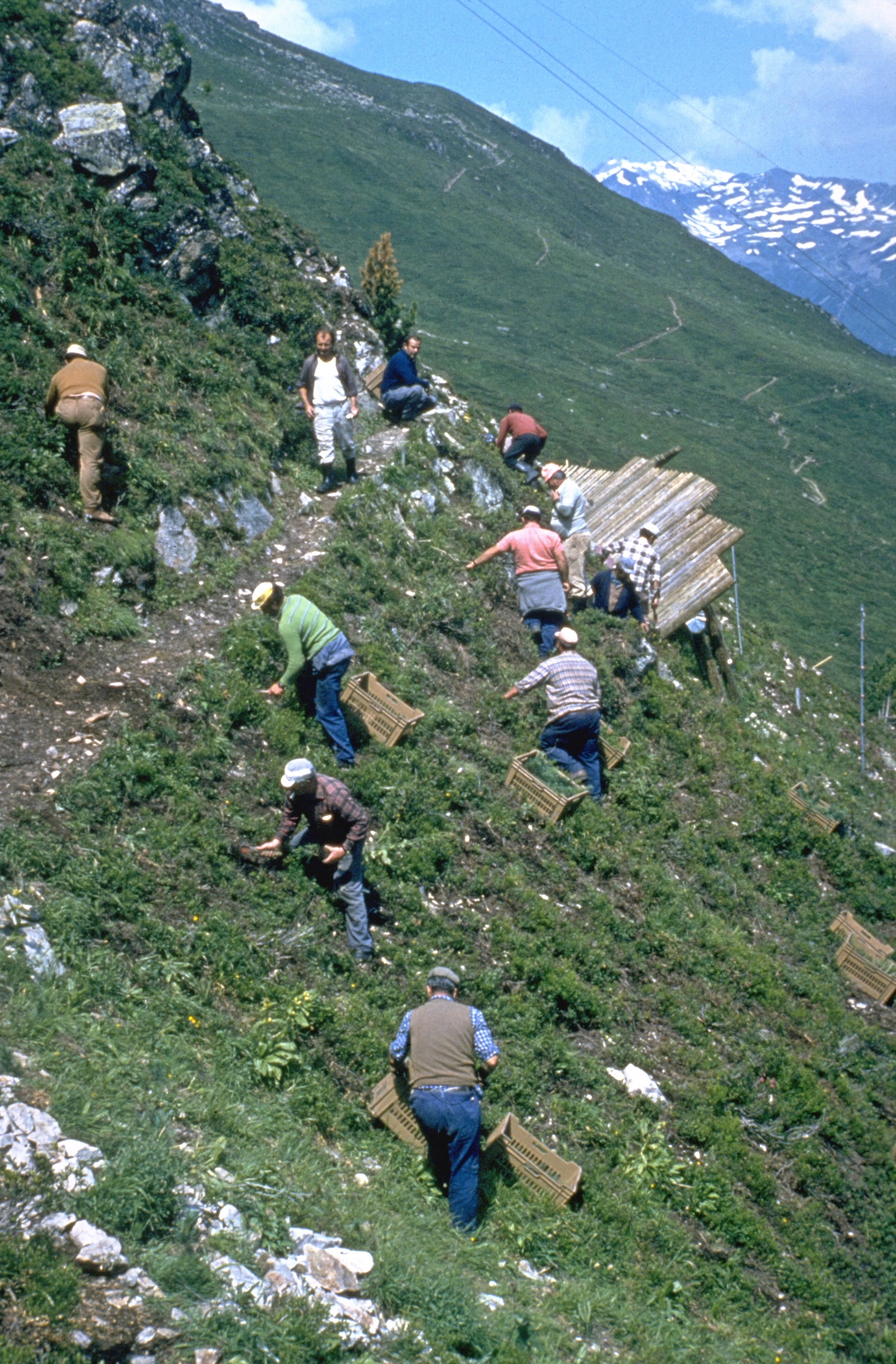

Measurement of soil respiration, i.e., how much CO₂ the soil releases. Photo: Christian Rixen / SLF
From avalanche protection to climate change research
While avalanche protection was once at the heart of research at Stillberg, the site has increasingly become a living laboratory for studying climate change. Today, researchers investigate tree growth at the treeline and the complex interactions between trees, snowpack, soil, and avalanches under changing environmental conditions.
A selection of ongoing research at Stillberg
Long-term monitoring of treeline trees (SLF/WSL)
From 1975 to 1995, the Swiss stone pines, mountain pines, and larches planted at Stillberg were intensively monitored. Since 1995, this work has continued with inventories conducted every ten years. By comparing current measurements with earlier surveys, researchers can assess how site conditions and neighbour interactions between trees have influenced tree growth over space and time.
Alpine treelines in a CO₂-rich and warmer future (WSL/SLF and partners)
To better understand how alpine treeline ecosystems may respond to future climate scenarios, trees and ground vegetation at the Stillberg treeline site were exposed to elevated CO₂ concentrations and warmer soil temperatures. This twelve-year experiment helped to reveal how plant growth, soil processes, and ecosystem dynamics might shift in the decades ahead.
Nutrient limitation experiment (SLF)
In this ongoing experiment initiated in 2004, researchers examine whether tree growth at the alpine treeline can be enhanced by annual low-dose fertilization (nitrogen, phosphorus, and potassium), representative of an increased nutrient supply under nitrogen deposition and climate warming. They additionally study whether this increased nutrient availability impacts biodiversity or makes trees more vulnerable to stress and disturbance.
Climate change in winter – plant responses (SLF)
By manipulating the snowpack to induce earlier snowmelt, researchers study how changes in winter conditions affect plant life cycles, growth, and reproduction. These experiments are conducted both in alpine dwarf shrub heathlands at Stillberg and, for comparison, in the subarctic tundra of Alaska.
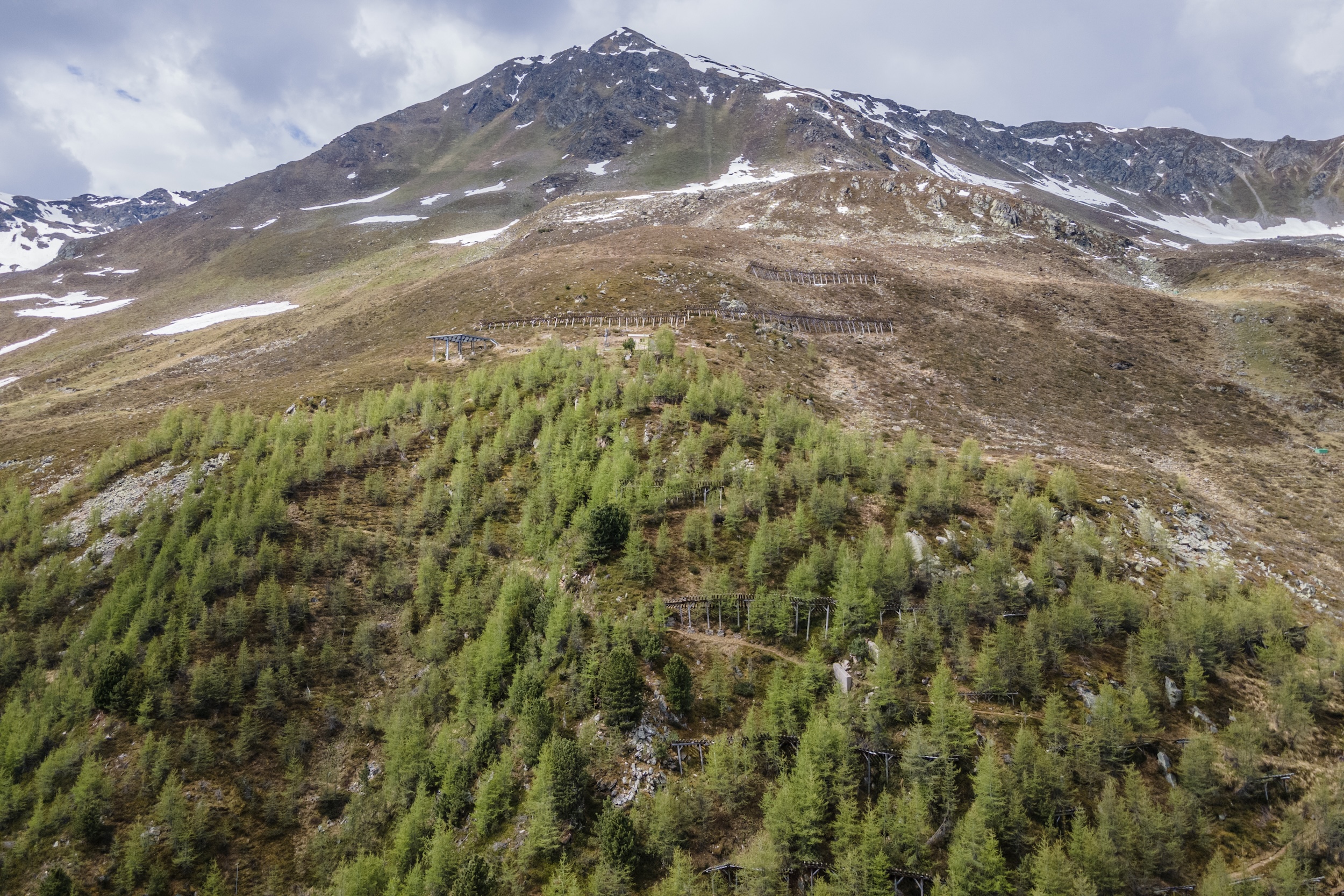 Photo: Evgeni Dimitrov/eLTER
A living archive of environmental change
Research at Stillberg near Davos began as early as the 1950s, making it one of the longest-running experimental sites of its kind. Established through the first joint research programme between the former EAFV (now WSL) and SLF, the site has continuously provided insights relevant for reforestation, natural hazards, and ecosystem dynamics at the alpine treeline.
Fifty years after the planting of the first seedlings, the steep slopes of Stillberg now stand as a living archive of environmental change. The anniversary celebration not only highlighted past achievements, but also underlined the site’s crucial role within long-term ecosystem research networks such as eLTER—helping scientists, policymakers, and the public better understand how mountain environments respond to both natural processes and human-induced climate change.
With special thanks to Melissa Dawes and Alessandra Bottero for their valuable help in creating this article!